THE $50,000 ADVERTISING GRAVEYARD...
Why Clients Don't Believe Your Google Ads (And What Works Instead)
Prospects don't trust paid ads - they trust demonstrated expertise. Here's how to generate organic legal leads without wasting another dollar on clicks that don't convert.

You spent $3,000 on Google Ads last month.
The clicks came in. The numbers looked good. Your dashboard showed activity.
But your phone? Silent.
Your consultation calendar? Empty.
Your bank account? Lighter by three grand.
Here's the uncomfortable truth nobody in the advertising world wants to tell you:
Your prospects don't trust your ads. They never did. They never will.
Not because they're stupid. Not because your ad copy is weak. Not even because your landing page needs work.
They don't trust your ads because nobody trusts ads anymore.
And in 2026, that trust deficit is costing attorneys hundreds of thousands of dollars in lost business.
The Psychology Behind Why Legal Ads Fail
Let's start with what's actually happening in your prospect's brain when they see your ad.
They're sitting at home, late at night, searching "DUI lawyer near me" because they got pulled over last weekend and just got a court date in the mail.
They're scared. Embarrassed. Worried about losing their license, their job, maybe even their freedom.
Your ad pops up at the top of Google: "Expert DUI Defense | Free Consultation | Call Now!"
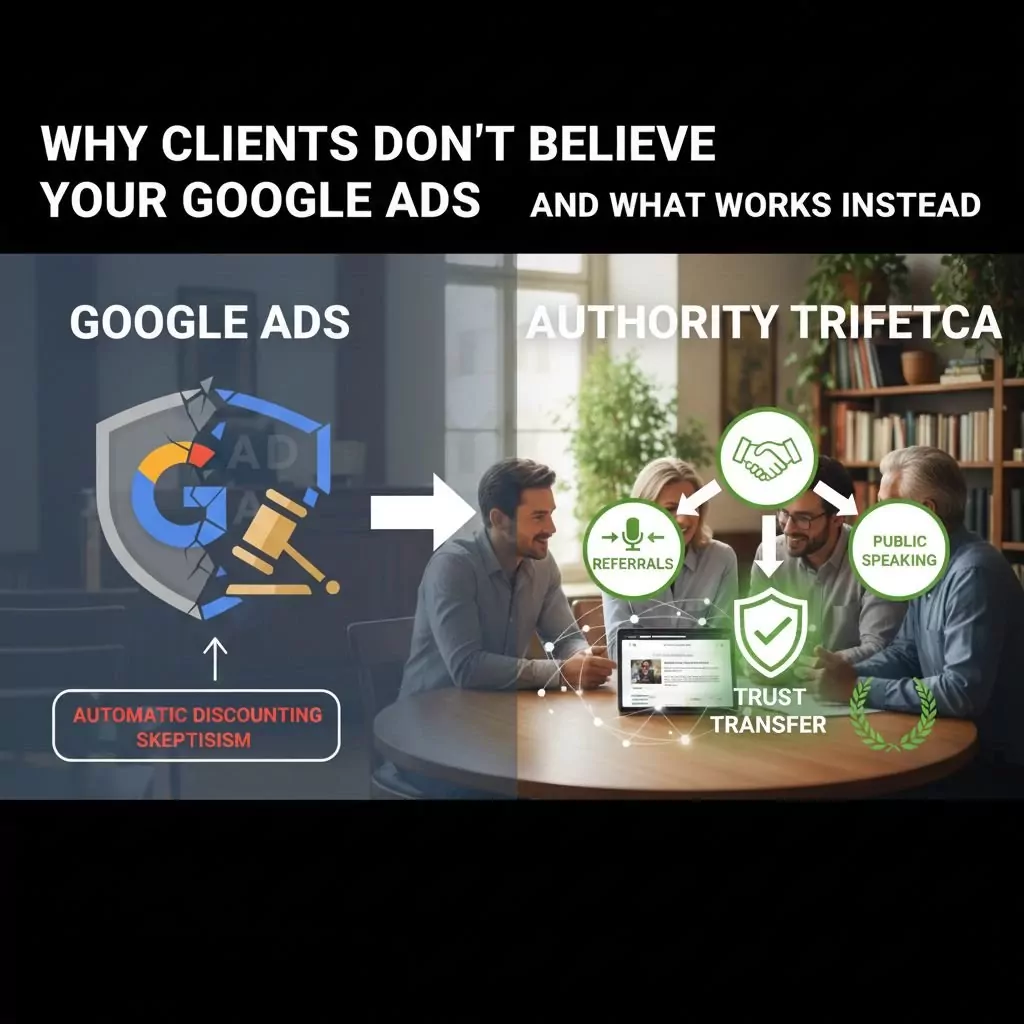
And their brain immediately does something called automatic discounting.
They think: "Of course they say they're experts. Everyone says that. It's an ad."
The ad sits in the "paid promotional content" box at the top of search results - literally labeled as advertising. Google might as well put a flashing sign: "THIS PERSON PAID TO BE HERE. SKEPTICISM RECOMMENDED."
Compare that to what happens when they scroll down and see an organic result - a blog post titled "What Actually Happens at Your First DUI Hearing in [Your State]."
Same attorney. Same firm. Different positioning.
But this time, their brain thinks: "This person is teaching me something valuable. They're not selling. They're helping."
That's the trust difference.
One looks like a transaction. The other looks like authority.
One triggers skepticism. The other triggers gratitude.
And gratitude, not clicks, is what turns prospects into retained clients.
The $50,000 Google Ads Graveyard
Let me show you the math on what this trust deficit actually costs.
Average criminal defense attorney spending on Google Ads: $2,000-$5,000 monthly.
Average cost-per-click in competitive legal markets: $40-$150.
Average conversion rate from ad click to consultation: 2-4%.
Average conversion rate from consultation to retained client: 30-50%.
Let's be generous and say you're on the better end of those ranges:
$3,000 monthly spend
$75 average CPC = 40 clicks
4% conversion rate = 1.6 consultations
40% retention rate = 0.64 clients
You paid $3,000 for 0.64 clients.
If your average case value is $5,000, you just spent $3,000 to generate $3,200 in revenue. That's a 6.7% profit margin before overhead, staff costs, or your time.
Now let's look at the attorney down the street who quit Google Ads two years ago and invested in authority building instead:
$0 monthly ad spend
200 monthly organic website visitors from content
12% conversion rate (pre-sold from content) = 24 consultations
65% retention rate (they already trust you) = 15.6 clients
Zero ad spend. 15-16 retained clients monthly.
Same market. Same services. Wildly different results.
The difference? Trust.
One is renting attention through ads. The other owns authority through content.
Why Referrals Work and Ads Don't (The Trust Transfer)
Think about the last time you hired an attorney.
Chances are, you didn't click on an ad. You asked someone you trusted.
Your cousin. Your neighbor. Your coworker. Someone who said: "I used this lawyer. They were great."
That's called trust transfer.
Your cousin's credibility transfers to the attorney they're recommending. You inherit their confidence. The sale is made before you ever visit the website.
Now, here's what most attorneys miss:
You can engineer trust transfer at scale without waiting for word-of-mouth.
How? By building visible authority that makes you the de facto referral - even from people who've never used your services.
When you create consistent, helpful content - articles, videos, social posts that actually solve problems - something interesting happens:
People who've never hired you start recommending you.
"I haven't used them personally, but I follow their stuff online. They really know their stuff."
That's an authority-driven referral. And it's more powerful than any ad you'll ever run.
Here's why:
Ads say: "I'm good. Hire me."
Authority says: "Let me help you understand this. By the way, I'm available if you need more help."
One is self-promotion. The other is service.
And in legal marketing, service builds trust faster than any paid click ever could.
The AI Search Problem That Makes Ads Even Less Effective
Here's something that's making the trust deficit exponentially worse:
Your prospects aren't just using Google anymore.
They're asking ChatGPT: "What should I know before hiring a DUI lawyer?"
They're asking Claude: "How do I find a good immigration attorney in my area?"
They're asking Perplexity: "What's the difference between a public defender and a private criminal defense attorney?"
And here's what none of these AI tools do: recommend attorneys who advertise.
AI systems pull from authority signals: content, reviews, structured data, expertise demonstrations, media mentions.
Your Google Ads? Completely invisible to AI.
So while you're spending $3,000 monthly to show up at the top of Google searches, your prospects are getting recommendations from AI assistants - and you're not even in the conversation.
The platforms are shifting. The trust signals remain the same.
AI recommends attorneys who demonstrate expertise consistently. Who publishes helpful content. Who build reputations through value, not volume.
That's why the attorneys who invested in authority three years ago are now dominating AI search results - while the attorneys still running ads are wondering why their leads dried up.
The market didn't disappear. It moved to platforms where ads don't work.
What Actually Builds Trust (The Authority Trifecta)
So if ads don't work and AI is eating traditional search, what does work?
Three things. That's it.
1. Consistent, Helpful Content
Not promotional. Not salesy. Actually helpful.
Blog posts answering the exact questions your prospects are Googling at 2 AM.
Videos breaking down complex legal processes in plain language.
Social media posts that demonstrate you understand their situation—not just that you want their money.
When someone finds your content, reads it, gets value from it, and then sees you're a local attorney... the sale is already made.
They're not looking for more options. They're looking for your phone number.
That's the power of educational authority.
You've already proven you can help them. Hiring you is the obvious next step.
2. Social Proof That AI Can Read
Reviews matter. Everyone knows that.
But in 2026, how you present reviews matters more than ever.
Because it's not just humans reading them anymore.
When you implement proper schema markup on your reviews, AI systems can parse and understand:
How many reviews you have
What your average rating is
What people specifically appreciate about your services
How consistently you deliver results
This is why schema markup is no longer optional.
It's the difference between AI seeing you as "an attorney in the area" versus "the 4.9-star criminal defense attorney with 87 reviews and a track record of reduced charges."
One is generic. The other is recommendable.
And AI systems don't recommend generic.
3. Visible, Consistent Presence
Here's the psychological trigger most attorneys miss:
Mere exposure effect.
The more often people see you, the more they trust you - even if they've never interacted with you directly.
This is why video content is so powerful.
When prospects see your face in their LinkedIn feed, their Instagram stories, their YouTube recommendations week after week...
Their brain starts thinking: "I know this person."
And "I know them" translates to "I trust them" faster than any logical argument ever could.
This is the ClipCred advantage - 25-30 videos monthly from one interview, distributed across every platform, creating omnipresence without overwhelming your schedule.
You show up everywhere. They feel like they know you. Trust builds automatically.
The Conversion Rate Multiplier Nobody Talks About
Let's talk about something most attorneys never measure: pre-qualification quality.
When someone clicks your Google Ad, you have no idea who they are or what they actually need.
They might be:
A serious prospect ready to hire
Someone just "researching" with no intent
A price shopper calling 15 attorneys
Someone in the wrong jurisdiction
Someone with a case type you don't even handle
Your conversion rate suffers because you're starting from zero.
Now compare that to someone who found you through content:
They've read your blog posts. They've watched your videos. They've seen your social media presence. They understand your approach, your values, your expertise.
By the time they call, they're not asking "Are you qualified?"
They're asking "Are you available?"
That's a pre-sold client.
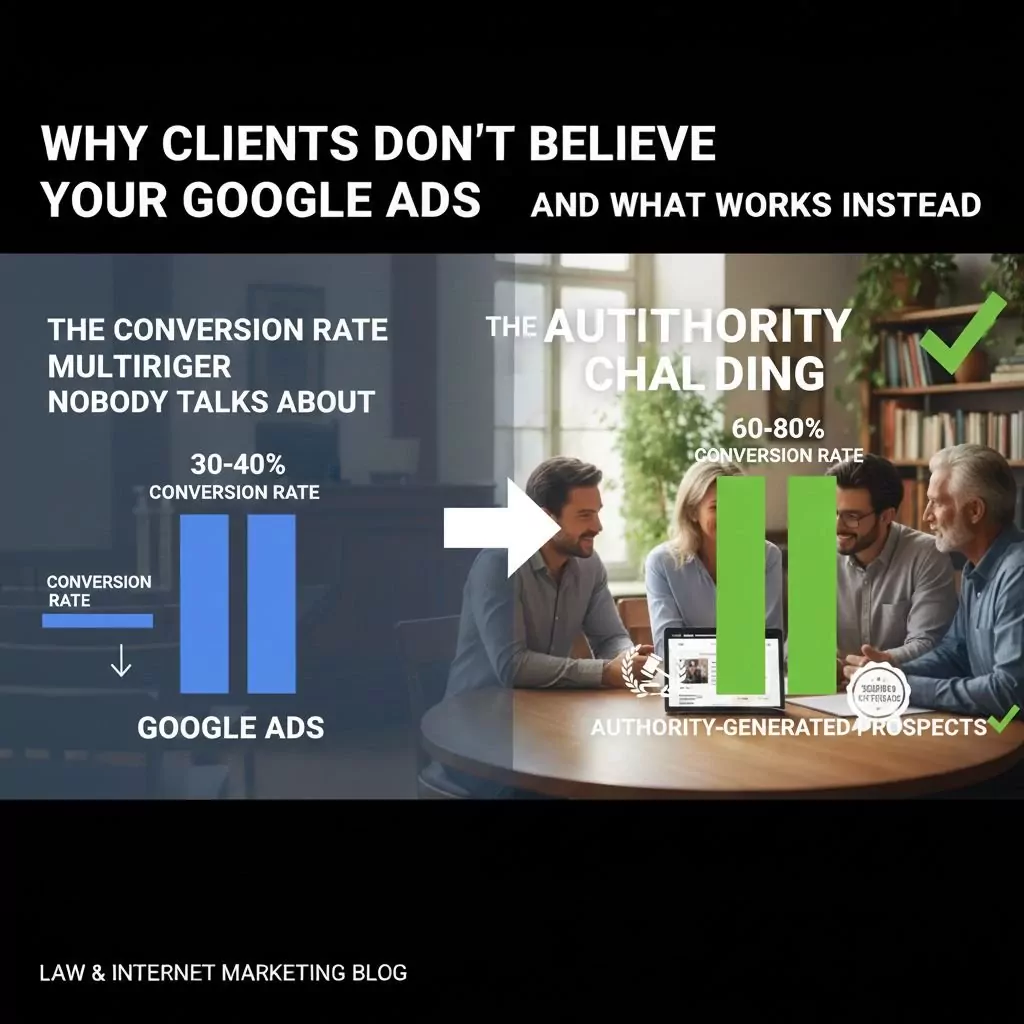
And pre-sold clients convert at 60-80% instead of 30-40%.
Same consultation. Half the effort. Double the retention rate.
The math isn't just better. It's transformative.
One attorney told me: "I used to do 10 consultations to get 3 clients. Now I do 10 consultations and get 7-8 clients. Same practice. Different marketing."
That's what authority building does.
It doesn't just generate leads. It generates qualified, pre-sold leads who already trust you.
The "But I Need Clients Now" Objection
I know what you're thinking:
"This sounds great for the long term. But I have bills to pay now. I can't wait six months to build authority."
Fair.
Here's the truth:
Authority building and paid advertising aren't mutually exclusive.
The smart play isn't "ads or content." It's "ads while building content."
Use Google Ads for immediate lead flow while you're building your authority foundation.
But - and this is critical - reduce your ad spend every quarter as your organic authority grows.
Month 1-3: $3,000 monthly on ads + start publishing weekly content
Month 4-6: $2,000 monthly on ads (organic leads starting to flow)
Month 7-9: $1,000 monthly on ads (organic leads now majority)
Month 10-12: $0-$500 monthly on ads (testing only, not reliant)
This is the transition strategy that protects your income while building sustainable growth.
But most attorneys never make the transition. They stay stuck in the ad dependency cycle because they never invested in the alternative.
Don't be that attorney.
The Real ROI Comparison
Let's do the math over 12 months.
Ad-Dependent Attorney:
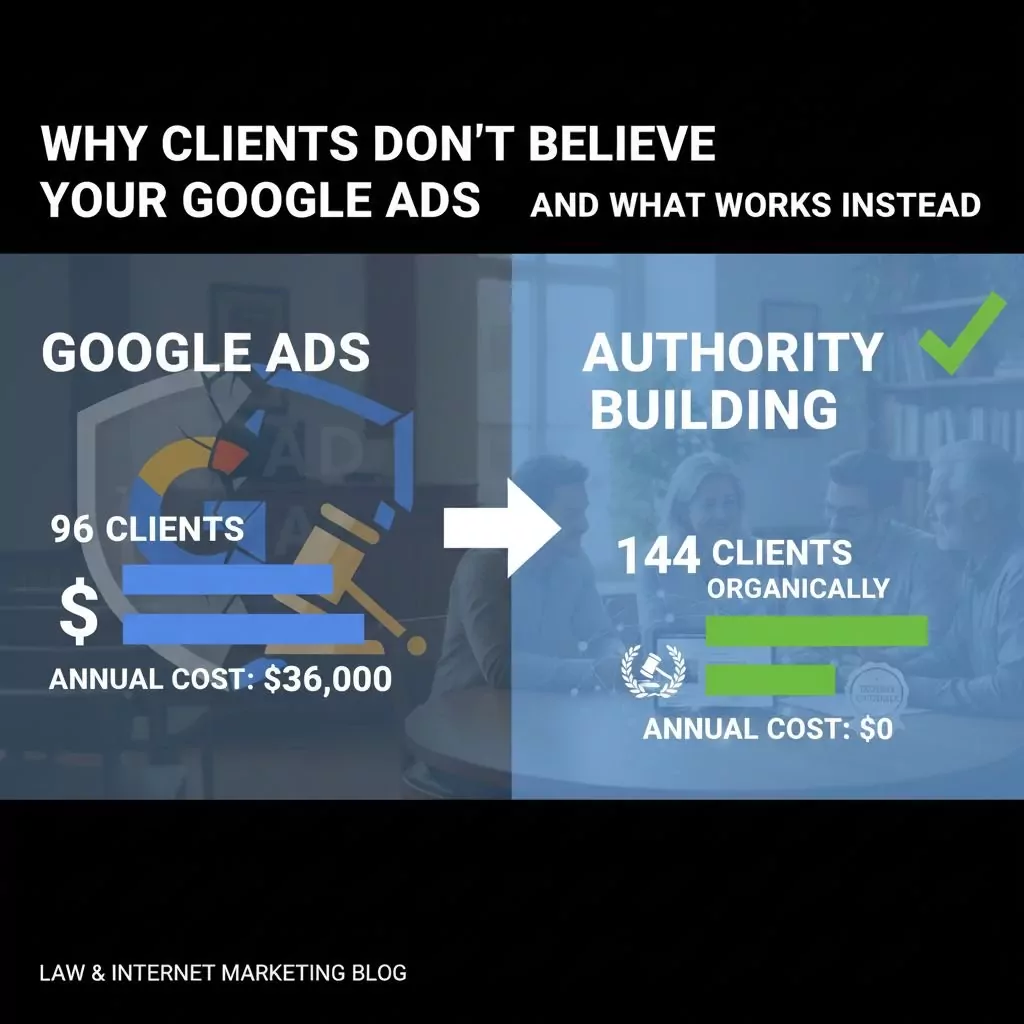
$3,000 x 12 months = $36,000 annual ad spend
~8 clients monthly = 96 annual clients
At $5,000 average case value = $480,000 revenue
$36,000 ad spend = 7.5% of revenue
Stop paying? Leads stop immediately.
Authority-Building Attorney:
$6,000 one-time website optimization (schema, SEO, conversion focus)
$2,000/month content creation (articles, videos, social) = $24,000 annually
First 6 months: 3-5 clients monthly from organic (slower ramp)
Months 7-12: 12-15 clients monthly from organic (compounding effect)
Year 1: ~70 clients from organic (lower than ads initially)
Year 2: 144+ clients from organic (no additional ad spend, momentum building)
At $5,000 average = $360,000 Year 1, $720,000+ Year 2
Stop creating content? Momentum continues for 12-18 months.
The Compounding Difference:
Year 1: Ads win on total clients (barely).
Year 2: Authority wins by 50%+.
Year 3: Authority wins by 200%+.
Year 5: It's not even close.
Because authority compounds. Ads don't.
Every blog post you write works forever. Every video you publish keeps generating views. Every piece of content builds on the last.
Meanwhile, ads stop the second you stop paying.
That's the difference between renting attention and owning authority.
How to Start Building Trust Today
You don't need to overhaul everything overnight.
Start with these three steps:
Step 1: Stop Apologizing for Not Running Ads
Ads aren't a prerequisite for success. They're one tactic among many - and increasingly, not even the best one.
Step 2: Publish Your First Educational Article
Pick the question you answer most often in consultations. Write 1,500 words explaining it clearly. Publish it on your blog.
That's your trust foundation.
Step 3: Add Schema Markup to Your Site
If AI can't read your credibility signals, you're invisible in AI search.
Schema markup costs $299-$600 one-time. It works forever.
Stop losing AI-generated referrals because your site speaks the wrong language.
That's it. Three actions. No massive budget. No agency retainer.
Just a commitment to building authority instead of renting attention.
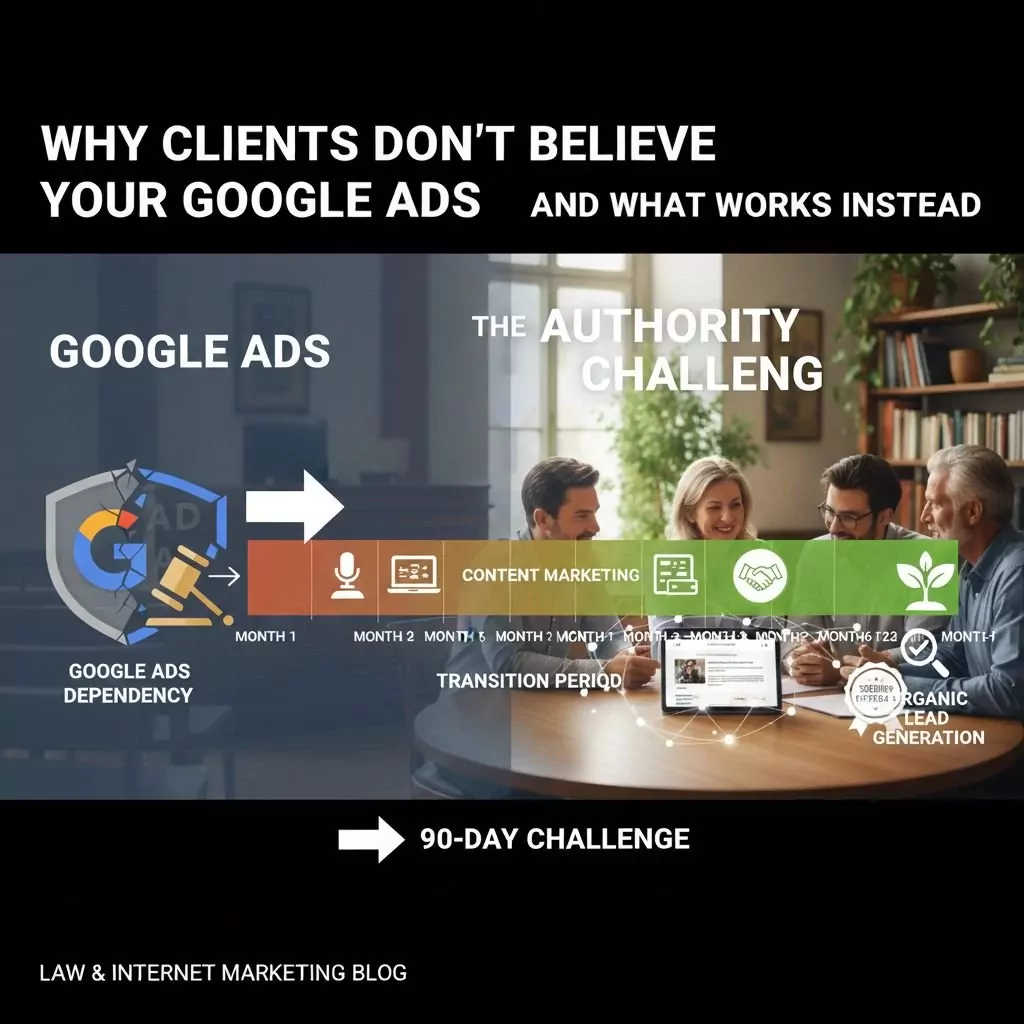
The 90-Day Authority Challenge
Here's what happens when you commit to authority building for 90 days:
Week 1-4:
Publish 4 blog posts (one weekly)
Optimize site with schema markup
Start one social media platform consistently
Week 5-8:
Publish 4 more blog posts
Add 2-4 short videos (if comfortable)
Engage with comments and questions
Week 9-12:
Publish 4 more blog posts
Increase video consistency (or consider ClipCred for scale)
Start seeing organic consultation requests
Results after 90 days:
12 published articles answering real client questions
8-16 video assets (if pursued)
2-5 organic consultation requests
Foundation built for compounding growth
Most importantly: You've created assets that work forever. Not ad spend that evaporates.
When Ads Actually Make Sense (Yes, Sometimes)
I'm not anti-advertising. I'm anti-dependency.
There are legitimate scenarios where Google Ads make strategic sense:
1. New Practice Launch
You just opened. You have zero organic presence. You need cash flow now.
Ads can bridge the gap while you build authority. Just don't stay dependent.
2. Seasonal Services
If you handle specific case types with seasonal demand (tax fraud during tax season), targeted ad campaigns make sense.
But only as a supplement to year-round authority.
3. Competitive Testing
Want to test messaging before creating content around it? Ads give you fast feedback.
But once you know what works, shift to organic content creation.
4. Retargeting Warm Traffic
If someone visited your site from organic search, retargeting ads can be effective.
You're not buying cold traffic - you're staying visible to people who already showed interest.
The rule: Use ads strategically, not dependently.
The moment ads become your only lead source, you're in a dangerous position.
The Future Is Authority, Not Advertising
Here's where legal marketing is headed:
AI search will dominate within 3-5 years. Google's market share is already declining.
ChatGPT, Claude, Perplexity - these are where prospects research now.
And none of them prioritize paid advertising. All of them prioritize demonstrated authority.
The attorneys who see this shift coming and invest in authority today will own their markets tomorrow.
The attorneys who keep dumping money into ads will wake up in 2028 wondering where all their leads went.
You get to choose which attorney you want to be.
The trust deficit isn't going away. It's getting worse.
But it's also creating the biggest opportunity in legal marketing in 20 years.
Because while everyone else is still renting attention, you can own authority.
And in a world where prospects don't trust ads, authority is the only currency that matters.
Ready to Build Authority That Replaces Your Ad Budget?
You don't need to figure this out alone.
Here's what we do at GSD Local:
✅ Schema Markup ($299 one-time) - Make your expertise visible to AI search
✅ Local SEO - Get found when prospects search (without paying per click)
✅ ClipCred Video System - 25-30 monthly videos from one interview
✅ Strategic Copywriting - Website copy that builds trust and converts
Stop renting attention. Start owning authority.
📞 Schedule Your Free Strategy Call
(509) 433-7730
We'll show you exactly where you're losing trust - and how to rebuild it without depending on ads.
Frequently Asked Questions
Do Google Ads still work for lawyers in 2026?
Google Ads can still generate clicks and traffic, but the fundamental problem is conversion and trust. The average criminal defense attorney pays $75-$150 per click with only 2-4% converting to consultations, and only 30-40% of those consultations becoming retained clients. This means you're often paying $3,000+ per retained client through ads.
The bigger issue is that prospects have developed "ad blindness" - they automatically discount paid search results as less credible than organic content. While ads can provide immediate visibility for new practices or emergency cash flow, they shouldn't be your primary long-term strategy.
The ROI calculation shifts dramatically when you factor in the quality of leads: ad-generated leads are cold and skeptical, while authority-generated leads are warm and pre-sold.
If you're currently running ads profitably, don't stop immediately - but start building your authority foundation so you can gradually reduce ad dependency over 12-18 months.
Why do prospects ignore my ads but respond to referrals?
This comes down to psychological trust transfer. When your neighbor refers an attorney, they're essentially lending their credibility to that professional - you inherit confidence from someone you already trust. Ads lack this trust transfer mechanism entirely; in fact, they trigger the opposite reaction called "automatic discounting" where your brain says "of course they claim to be good, they paid to say that."
Referrals also signal social proof and real-world results in ways ads cannot replicate. The prospect thinks: "This person actually used them and was happy enough to recommend them" - that's fundamentally different from "This business paid Google to show me this message." The solution isn't to give up on marketing; it's to engineer trust transfer at scale through authority building.
When you create consistent, helpful content that demonstrates expertise, people who've never hired you start recommending you to others, saying "I follow their content, they really know their stuff." This is authority-driven referral, and it's more powerful than any ad because it mimics the psychological mechanism that makes personal referrals work.
What's the difference between visibility and credibility?
Visibility is being seen; credibility is being trusted. Google Ads buy you visibility - your name appears at the top of search results. But visibility without credibility is worthless in legal services where stakes are high and trust is paramount. You can have 10,000 people see your ad, but if none of them trust you, you get zero clients.
Credibility, on the other hand, is earned through demonstrated expertise: publishing helpful content, answering questions prospects are asking, showing up consistently with valuable insights, and building a reputation as someone who helps first and sells second. Credibility takes longer to build than visibility takes to buy, but credibility converts at 3-5X higher rates and costs nothing to maintain once established.
The smart strategy is using paid visibility (ads) for immediate needs while simultaneously building credibility (authority content) for long-term sustainable growth. Most attorneys get stuck buying visibility forever because they never invest in credibility, staying trapped in the expensive cycle of renting attention rather than owning authority.
How do I build trust with people who haven't met me yet?
Trust with strangers is built through three mechanisms: expertise demonstration, consistency, and the mere exposure effect. First, demonstrate expertise by publishing content that solves real problems - blog posts answering the exact questions prospects Google at 2 AM, videos explaining complex legal processes in plain language, social media posts showing you understand their situation.
When someone reads your article and thinks "this actually helped me," trust begins immediately. Second, show up consistently - weekly blog posts, regular videos, daily social media presence. Consistency signals reliability, and prospects subconsciously think "if they show up this consistently for free content, they'll show up for me as a client." Third, leverage the mere exposure effect: the more often people see you, the more they trust you, even without direct interaction. This is why video content is so powerful - when prospects see your face repeatedly in their feeds, their brain starts thinking "I know this person," which translates to "I trust this person."
This is exactly what our ClipCred system does - creating 25-30 videos monthly from one interview, giving you omnipresence across platforms without overwhelming your schedule, building trust through repeated exposure while you focus on serving clients.
Can content marketing really replace my ad budget?
Yes, but not overnight, and the transition requires strategic planning. Content marketing generates compound returns while ads generate linear returns - every dollar in ads generates one dollar of results, but every piece of content generates returns indefinitely.
Here's the realistic timeline: Months 1-3, start publishing weekly content while maintaining current ad spend; you'll see minimal organic leads. Months 4-6, organic consultation requests begin appearing as content gains traction; reduce ad spend by 30%. Months 7-9, organic leads become majority of pipeline; reduce ads by another 50%. Months 10-12, organic authority generates consistent flow; ads become optional testing budget.
The math works because conversion rates dramatically improve: ad-generated consultations convert at 30-40% to retained clients, while authority-generated consultations convert at 60-80% because prospects are pre-sold. A real example: one criminal defense attorney spent $36,000 annually on ads generating 96 clients. After 18 months of content marketing investment ($24,000 total), he generated 144 clients annually from organic authority with zero ongoing ad spend.
Can content replace ads? Absolutely. Will it happen in 30 days? No. That's why the smart strategy is transitioning gradually, using ads to fund your practice while building the authority that eventually makes ads unnecessary.
What if I don't have time to create content consistently?
The "no time" objection is real - you're busy serving clients, appearing in court, managing a practice. But here's the reframe: you don't have time NOT to build authority. Every month you delay is another month dependent on expensive ads or hoping for random referrals.
The solution isn't finding more time; it's leveraging systems that create content from activities you're already doing. For example, you already answer the same questions in every consultation - what if those answers became blog posts? You already explain legal processes to clients - what if those explanations became videos? The key is extraction, not creation from scratch.
This is where done-for-you systems become worth their weight in gold. Our Local SEO service includes weekly blog content - we write it, you just approve it. Our ClipCred system creates 25-30 professional videos from one 60-minute monthly interview where you simply answer questions we prepare based on what your prospects are searching. You're not "creating content" - you're having a conversation, and we handle everything else: editing, posting, distribution, optimization. Time excuse solved.
The attorneys who build authority aren't working harder; they're working with better systems that extract maximum marketing value from minimal time investment.
How long before I can reduce or eliminate ad spending?
The realistic timeline for reducing ad dependency is 9-12 months of consistent authority building, with complete ad elimination possible by month 18-24.
Here's the phased approach that protects your revenue while building sustainable lead generation: Phase 1 (Months 1-3), maintain full ad budget while publishing 4-6 pieces of content monthly and optimizing your website with schema markup - you'll see minimal organic leads but you're building foundation. Phase 2 (Months 4-6), organic consultation requests start appearing as your content library grows and compounds; reduce ad spend by 25-30% and reallocate savings to content creation. Phase 3 (Months 7-9), organic leads become 50%+ of pipeline as your authority establishes; reduce ad budget by another 40-50%, keeping minimal spend for retargeting warm traffic. Phase 4 (Months 10-12), organic authority generates majority of qualified leads; ads become optional testing budget of $500-$1,000 monthly. Phase 5 (Months 13-18), full authority independence achieved; zero ad dependency, all leads from organic content, referrals, and AI search recommendations.
The key is patience and consistency - authority compounds slowly but powerfully. Most attorneys quit too early (month 3-4) when they don't see immediate results, not realizing they're 2-3 months away from the inflection point where organic leads begin flooding in.
Commit to 12 months, track your metrics monthly, and trust the compound curve. Your competitors will still be burning $3,000/month on ads while you're generating superior leads for free.
GSD Local
130 11th St NE
East Wenatchee, WA 98802
(509)-433-7730

© 2025 GSD Local
Services
- Local SEO
- Schema Markup
- ClipCred Video Marketing
- Website Design
- Copywriting
- Social Media Management
- Google Business Profile Mgt
- Press Release