
THE TECHNICAL GAP COSTING YOU CLIENTS...
How to Appear in AI Search Results: The Complete Schema Markup Guide for Professionals
The Structured Data Investment That Returns 20X-30X

Your website looks great.
Professional design. Clear messaging. Compelling calls to action.
But when someone asks ChatGPT for a recommendation in your field, your name doesn't come up.
When they Google your service, AI Overviews cite your competitors.
What's the difference?
One word: Schema.
And if you don't know what that means, you're already losing.
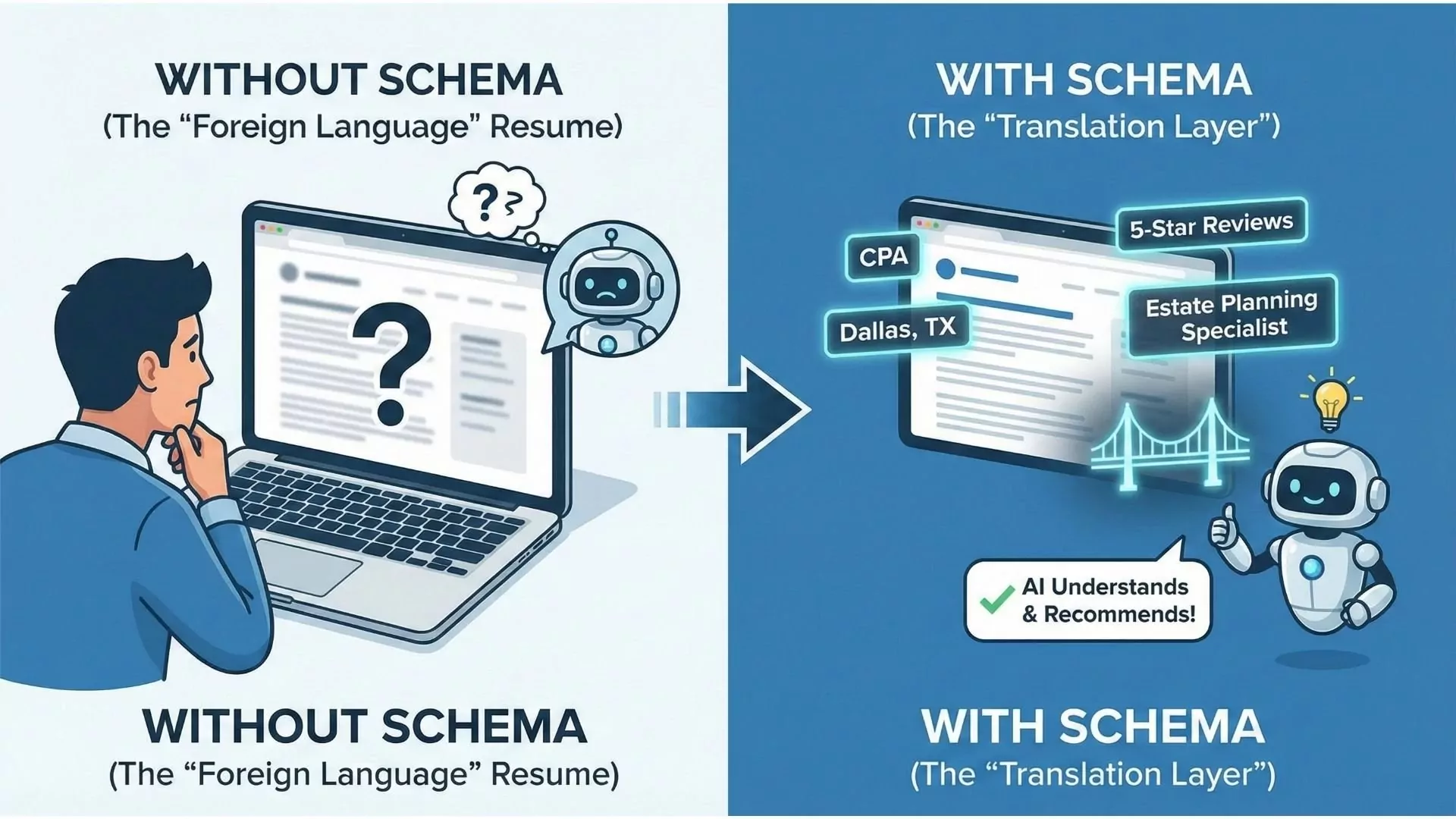
What Schema Markup Actually Is (In Plain English)
Forget the technical jargon for a second.
Think of your website like a resume written in a foreign language.
The words are all there. Your experience, expertise, services—everything's on the page.
But Google, ChatGPT, and other AI systems? They can't read it clearly.
They see text. Paragraphs. Sentences. But they don't understand:
What you do
Where you serve clients
What makes you credible
How to contact you
Why you're an authority
Schema markup is the translation layer.
It takes your website content and converts it into a language AI systems can read, understand, and act on.
Think of it as labels on your content:
"This person is a CPA"
"They serve clients in Dallas, TX"
"They specialize in small business tax strategy"
"They have 47 five-star reviews"
"They've been practicing since 2015"
Without schema, AI is guessing what your site means.
Why AI Systems Can't Recommend You Without Schema
Here's the uncomfortable truth:
ChatGPT doesn't browse your beautiful website like a human does.
It scans structured data. Organized information. Clear signals.
When someone asks: "Who's a good financial advisor in Phoenix?"
ChatGPT looks for professionals with:
Structured job title data
Geographic service area data
Review/rating data
Credential/certification data
Business information data
If your website lacks schema, you're invisible to this process.
Understanding where to focus your schema optimization-whether Google AI
Overviews or ChatGPT-helps you prioritize implementation for maximum ROI
based on your specific goals and audience behavior.
Your competitor with proper schema? Their information loads instantly. Clean. Clear. Verifiable.
AI recommends who it can verify-not who it has to guess about.
This is exactly why ChatGPT recommends your competitor instead of you-
they have the structured data AI needs to make confident recommendations
while your website remains unreadable to algorithms.
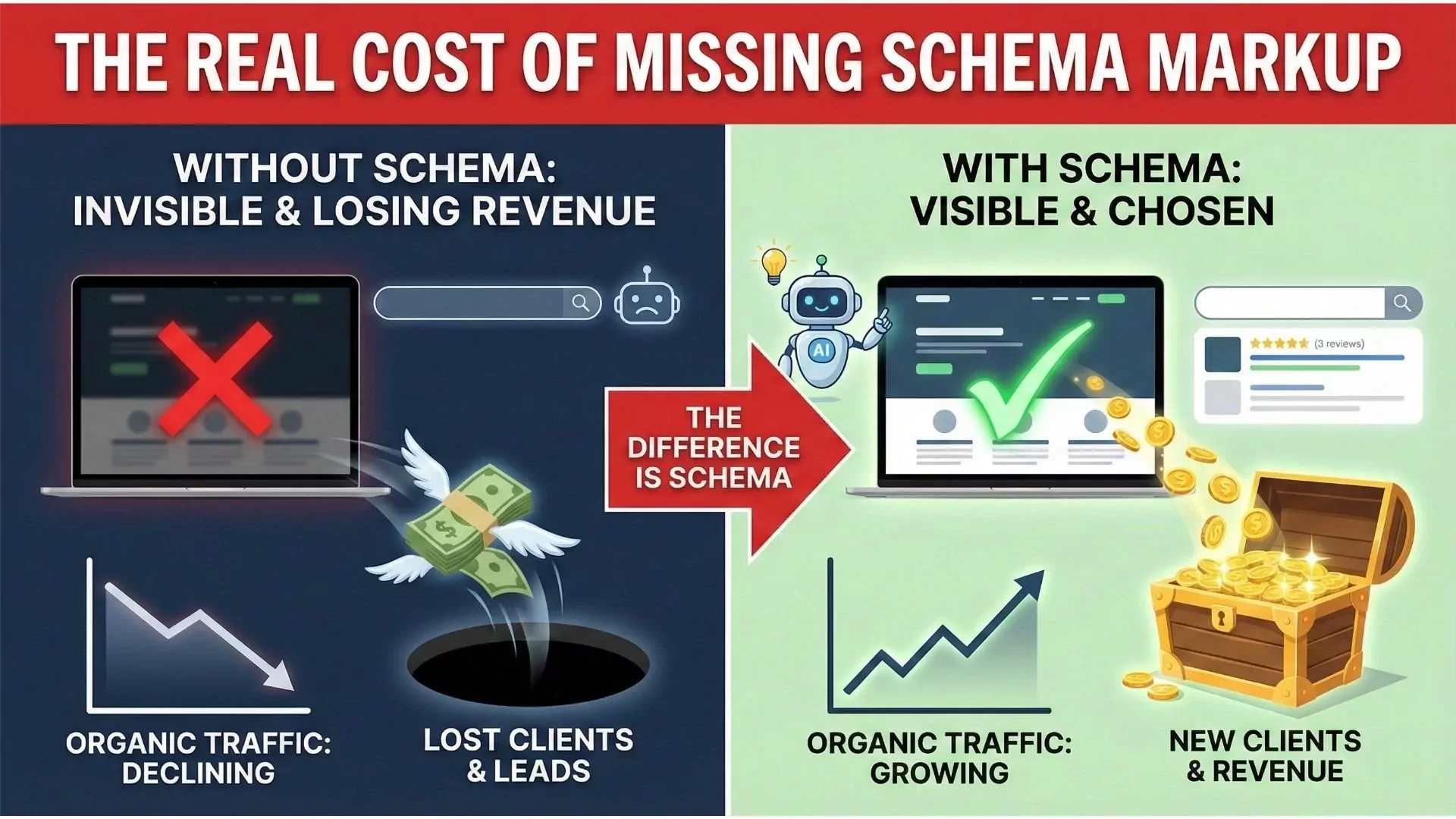
The Real Cost of Missing Schema Markup
Let's talk about what you're actually losing.
Search Visibility
Google uses schema to create rich results:
Star ratings showing in search
Business hours displaying
Service lists appearing
Contact info surfacing
Without schema: Plain blue link (if you rank at all)
With schema: Rich result with reviews, ratings, business info
Which do you think gets more clicks?
AI Recommendations
ChatGPT, Claude, Perplexity—they all prioritize professionals with clear structured data.
Without schema: "I don't have enough information to recommend specific professionals"
With schema: "I'd suggest Jane Smith, CPA. She specializes in small business tax strategy and has excellent reviews."
That's the difference between invisible and chosen.
Local Pack Rankings
Google's local 3-pack (the map results at the top) heavily weighs schema signals.
Without schema: You might rank page 2-3
With schema: You compete for top 3 positions
Top 3 gets 70%+ of clicks. Everything else gets scraps.
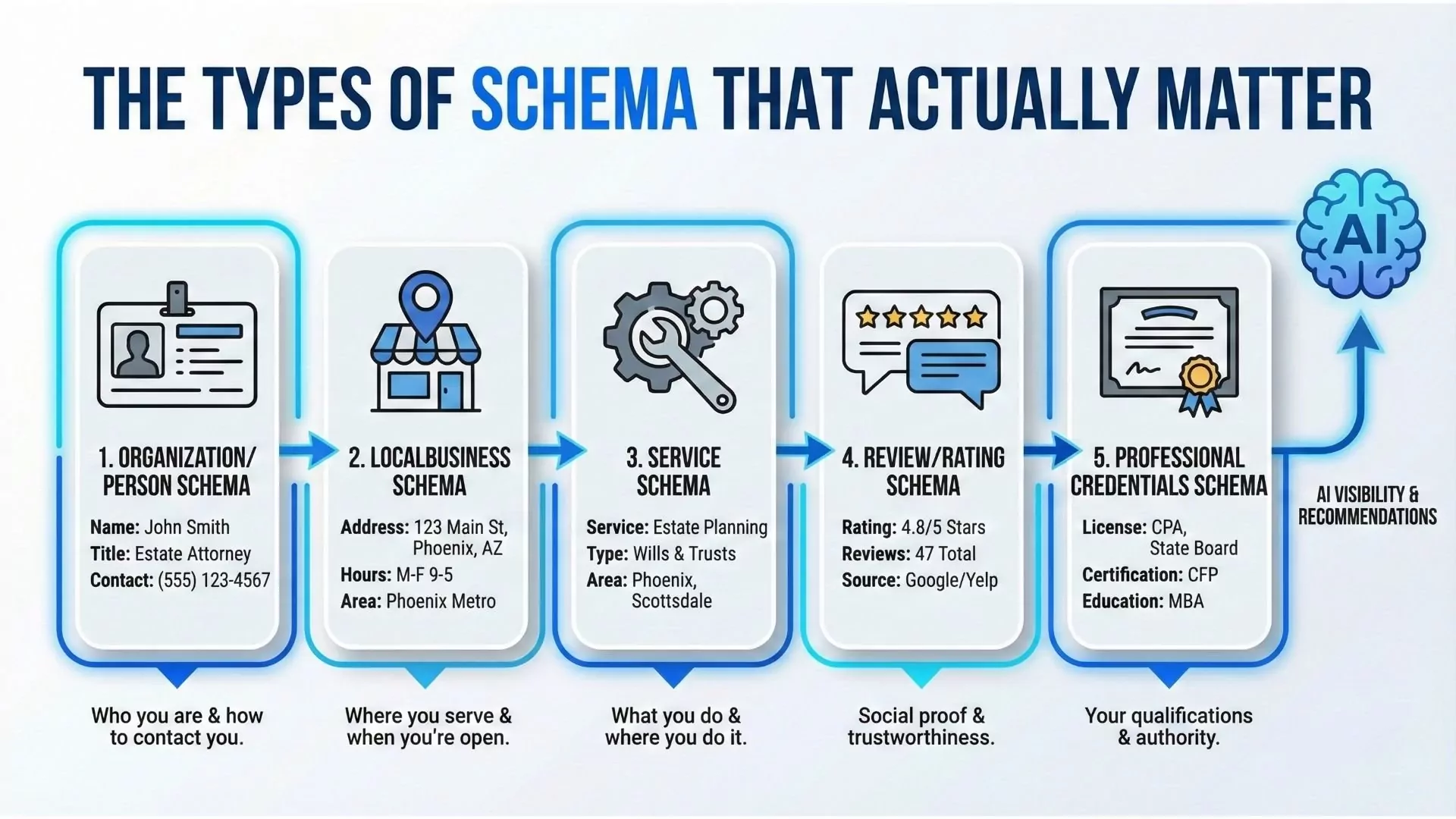
The Types of Schema That Actually Matter
Not all schema is created equal.
Here's what moves the needle for professionals:
1. Organization/Person Schema
This tells AI who you are fundamentally.
What it includes:
Your name
Job title/business name
Logo/photo
Contact information
Social media profiles
Founded date
Why it matters: Foundation for everything else. AI can't recommend you if it doesn't know you exist.
2. LocalBusiness Schema
This tells AI where you serve clients.
What it includes:
Physical address
Service area (cities/regions)
Business hours
Geographic coordinates
Phone number
Why it matters: Local searches dominate professional services. "CPA near me," "financial advisor in [city]"-schema determines who appears.
3. Service Schema
This tells AI what you actually do.
What it includes:
Services offered
Service descriptions
Service areas
Pricing (optional)
Service types
Why it matters: AI matches services to queries. "Estate planning attorney" only shows up if your schema says you do estate planning.
4. Review/Rating Schema
This tells AI people trust you.
What it includes:
Aggregate rating (4.8 stars)
Number of reviews (47 reviews)
Individual review text
Reviewer names/dates
Why it matters: Trust signals matter more than anything. 50 reviews beats 3 reviews every time in AI recommendations.
Review schema showcases your Trust Currency-the accumulated digital
credibility that makes AI systems confident recommending you over
competitors who lack verifiable social proof.
5. Professional Credentials Schema
This tells AI you're qualified.
What it includes:
Licenses
Certifications
Education
Memberships
Awards
Why it matters: "CPA" vs "tax preparer," "CFP" vs "financial advisor"-credentials determine authority.
What Schema Looks Like (Without Being Technical)
You don't need to understand code to grasp the concept.
Your website says: "John Smith has been helping families with estate planning since 2010. He's a board-certified attorney serving Phoenix and surrounding areas."
Schema translates this to:
Person: John Smith
Job Title: Estate Planning Attorney
Specialization: Estate Planning, Wills, Trusts
Service Area: Phoenix, Scottsdale, Tempe, Mesa
Years Experience: Since 2010
Credentials: Board Certified, Arizona Bar Association
One is prose. The other is data AI can act on.
That's the difference.
Why Most Professional Websites Lack Schema
Here's why you probably don't have it:
Reason 1: Your Web Designer Doesn't Know About It
Most designers focus on aesthetics. Pretty layouts. Nice colors.
Schema is invisible. It doesn't make your site "look" better.
So they skip it. Or don't even know it exists.
Reason 2: DIY Website Platforms Don't Include It
Wix, Squarespace, basic WordPress—they don't add comprehensive schema automatically.
You get basic stuff. Maybe.
But the deep schema that makes AI recommend you? Missing.
Reason 3: It Seems Technical and Intimidating
When you Google "schema markup," you get JSON-LD code blocks and technical documentation.
It looks scary. So you avoid it.
But here's the truth: You don't need to code it yourself. You just need to know it matters and hire someone who can implement it.
The Schema Implementation That Changed Everything
Real story. Real numbers.
Marcus is a financial advisor in Austin. Smart guy. Good at his job. Terrible at getting found online.
Before Schema (Year 1):
Nice website (cost $3,500)
Good content
Active on LinkedIn
Zero schema markup
Results:
Ranked page 2-3 for target keywords
Never appeared in ChatGPT recommendations
Got 2-3 organic leads monthly
Local pack: Nowhere
He was invisible where it mattered.
After Schema Implementation (Year 2):
His developer added comprehensive schema:
Organization schema
LocalBusiness schema
Service schema (financial planning, retirement, estate)
Review aggregation (32 five-star reviews)
Professional credentials (CFP, CFA)
Cost: $2,500 one-time
Results after 90 days:
Ranked top 3 for 8 target keywords
Appeared in Google's local pack
Started showing in ChatGPT recommendations
Organic leads jumped to 15-20 monthly
His reflection: "I spent $3,500 on a pretty website that did nothing. Then $2,500 on invisible code that changed my business."
Schema is the most overlooked marketing investment professionals make.
Schema provides the technical foundation, but video content creates
the 10X multiplier effect-discover why professionals with both schema
and consistent video presence dominate AI recommendations.
How to Check If You Have Schema (Right Now)
Want to know if your site has proper schema?
Test 1: Google's Rich Results Test
Go to: https://search.google.com/test/rich-results
Enter your website URL.
If you have good schema: Green checkmarks. "Page is eligible for rich results."
If you don't: Errors or "No rich results detected."
Takes 30 seconds. Shows you exactly where you stand.
Test 2: View Source Test
Right-click your homepage. Select "View Page Source."
Search (Ctrl+F) for "schema.org"
If you have schema: You'll see JSON-LD code blocks with schema.org references.
If you don't: No results found.
Not technical. Just shows presence or absence.
Test 3: AI Recommendation Test
Ask ChatGPT: "Who's a good [your profession] in [your city]?"
If your name comes up: You probably have decent schema.
If it doesn't: Schema is likely missing or incomplete.
Brutal but honest feedback.
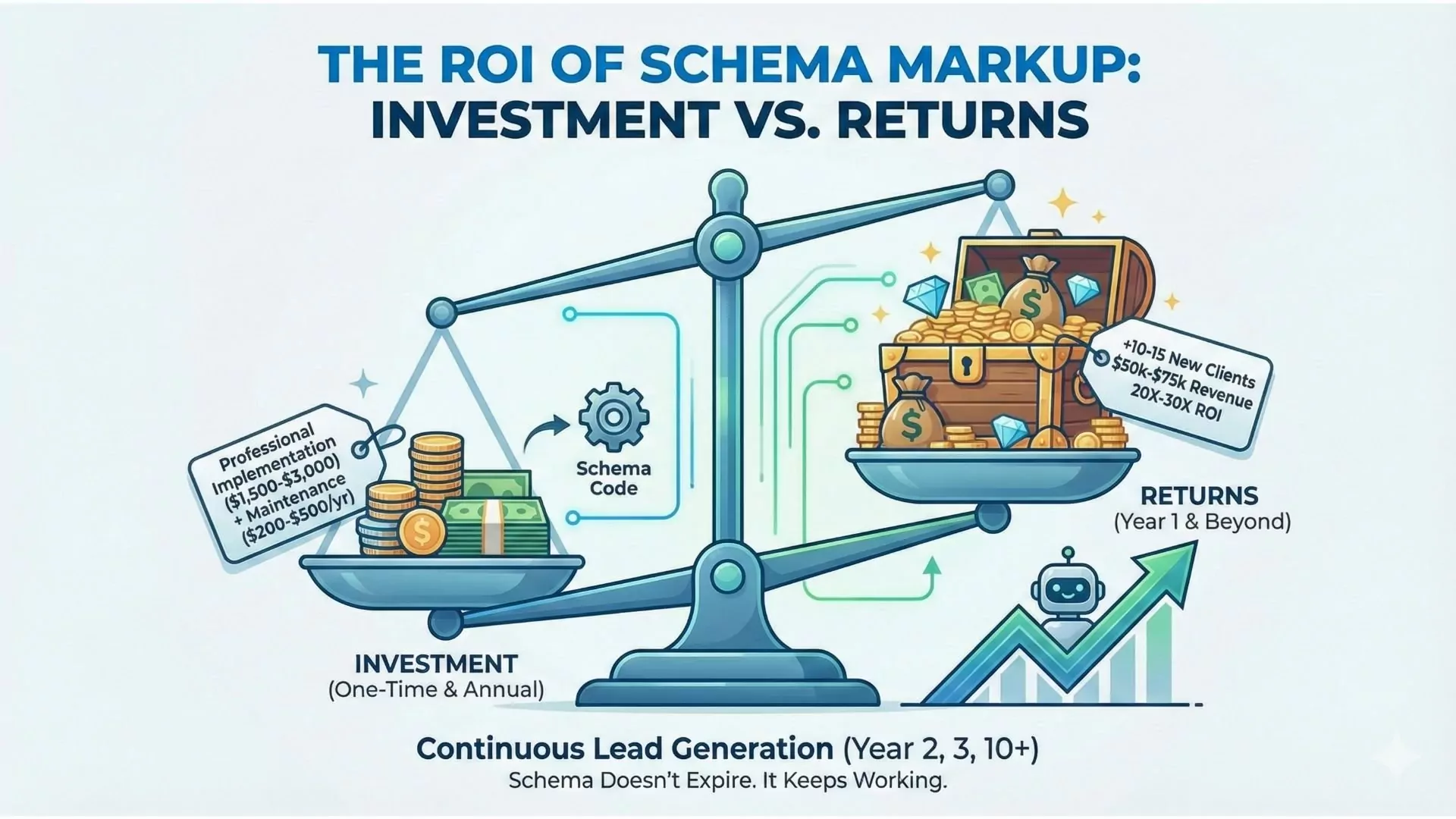
The ROI of Schema Markup
Let's talk money.
Investment:
Professional schema implementation: $1,500-$3,000 one-time
Ongoing maintenance: $200-500 annually
Returns (First Year):
10-15 additional clients from improved visibility
Average client value: $5,000
Total new revenue: $50,000-$75,000
ROI: 20X-30X
But here's what makes it even better:
Schema doesn't expire. It keeps working. Forever.
That $2,500 investment? It generates leads year 2, year 3, year 10.
Most profitable marketing dollar you'll ever spend.
This permanent asset approach mirrors why authority marketing replaces
paid lead generation-both create equity that compounds rather than
expenses that disappear when you stop paying.
Schema combined with consistent content creation triggers the Authority
Flywheel-where each element compounds the effectiveness of everything
else, creating exponential rather than linear growth.
Common Schema Mistakes That Kill Your Visibility
Even professionals with schema often do it wrong.
Mistake 1: Basic Schema Only
They add Organization schema. That's it.
Missing: Services, reviews, credentials, local business info.
Impact: You're 20% visible instead of 100% visible.
Mistake 2: Outdated Schema
They added schema in 2019. Haven't touched it since.
Business moved. Added services. Got more reviews.
Impact: AI sees old information. Recommends accordingly.
Mistake 3: Conflicting Information
Website says "serving Phoenix metro."
Schema says "Phoenix, AZ 85001" (just one zip).
Impact: AI gets confused. Doesn't recommend you.
Mistake 4: Missing Review Schema
They have 50 five-star Google reviews.
But no review schema on their website.
Impact: AI doesn't see the social proof. Trust signals wasted.
The Four-Step Schema Implementation Plan
Here's how to actually get this done:
Step 1: Audit Current State (Week 1)
Run Google Rich Results Test
Check for existing schema
Identify gaps
Document what's missing
Cost: Free (DIY) or $300 (professional audit)
Step 2: Define Your Schema Strategy (Week 1)
Determine what schema types you need:
Organization/Person (everyone needs this)
LocalBusiness (if serving specific area)
Service (list all services offered)
Review/Rating (aggregate your reviews)
Professional credentials (licenses, certs)
Cost: Free (planning)
Step 3: Implement Schema (Week 2-3)
Hire a developer who knows JSON-LD schema.
They'll add:
Structured data to homepage
Service-specific schema to service pages
Review schema throughout site
Local business schema with service areas
Cost: $1,500-$3,000 (one-time)
Step 4: Validate & Monitor (Week 4+)
Run Rich Results Test again (should be green)
Test in ChatGPT (search for yourself)
Monitor rankings (should improve)
Track organic leads (should increase)
Cost: Free (ongoing)
Schema for Different Professions (What You Actually Need)
Lawyers/Attorneys:
Attorney schema
LegalService schema
Practice area schema
Bar admissions
Case types
CPAs/Accountants:
AccountingService schema
Professional credentials (CPA, EA)
Service types (tax prep, planning, audit)
Industries served
Financial Advisors:
FinancialService schema
Credentials (CFP, CFA, ChFC)
Service areas (retirement, estate, investment)
Fiduciary status
Real Estate Agents:
RealEstateAgent schema
Service areas (neighborhoods, cities)
Property types (residential, commercial)
Brokerage information
Real estate agents need this comprehensive schema foundation to appear
in AI search—learn the complete visibility strategy for how top agents
dominate ChatGPT and AI recommendations in competitive markets.
Consultants:
ProfessionalService schema
Consulting areas
Industries served
Credentials/certifications
Each profession needs specific schema types. Generic schema doesn't cut it.
Why "Pretty Website" Doesn't Equal "Findable Website"
Your web designer made your site beautiful.
Clean layout. Professional photos. Smooth animations.
But if AI can't read it, clients can't find it.
Beauty is for humans. Structure is for AI.
You need both.
A $5,000 website without schema loses to a $2,000 website with schema.
Every. Single. Time.
Because visibility beats aesthetics in revenue generation.
This exemplifies why smart marketing investment focusing on results
always outperforms cheap tactics that prioritize appearance over
functionality-beautiful but invisible is the worst combination.
The AI Visibility Test (Do This Right Now)
Here's your homework:
Go to ChatGPT
Ask: "Who's a good [your profession] in [your city]?"
See if your name appears
If YES: Your schema is probably solid. Keep doing what you're doing.
If NO: You're losing clients to competitors with better structured data.
That's the test. Pass or fail. No middle ground.
Why Your Competitor Shows Up and You Don't
They're not smarter. They're not better at their craft.
They just speak AI's language.
While you invested in beautiful design, they invested in structured data.
While you focused on how your site looks, they focused on how AI reads it.
Six months later, they're getting 20 leads monthly from AI recommendations.
You're getting zero.
Same market. Same credentials. Different visibility.
Schema is the difference.
Stop Being the Best-Kept Secret in Your Market
You're good at what you do. Maybe great.
But if AI can't understand your website, potential clients never find you.
They find your competitor. The one with proper schema.
You're not losing because you're worse. You're losing because you're invisible.
Schema fixes that.
Schema is the technical foundation of building an AI-driven reputation
that makes you the default recommendation when ChatGPT, Claude, or
Perplexity suggests professionals in your field.
Ready to finally appear in AI search results?
📞 Schedule a free 15-minute Schema Audit and we'll show you exactly what's missing from your website—and how much visibility you're leaving on the table.
Because pretty websites don't generate leads.
Structured websites do. Contact me today!
Frequently Asked Questions
What is schema markup and why do professionals need it?
Schema markup is structured data code that translates your website content into a format AI systems can easily read and understand. Think of it as labels for your content that tell Google, ChatGPT, and other platforms exactly who you are, what you do, where you serve clients, and why you're credible. Without schema, AI systems see unstructured text and must guess your profession, services, and qualifications-often guessing wrong or simply not including you in recommendations. With schema, AI knows you're a "Financial Advisor in Phoenix specializing in retirement planning with CFP certification and 45 five-star reviews." This clarity is why professionals with schema appear in AI recommendations 10X more often than those without it.
How much does schema markup implementation cost?
Professional schema implementation typically costs $1,500-$3,000 as a one-time investment, with $200-500 annually for updates and maintenance. This includes comprehensive coverage: Organization/Person schema, LocalBusiness schema for your service area, Service schema for what you offer, Review aggregation schema, and professional credentials markup. While this might seem expensive, the ROI is exceptional-most professionals see 10-15 additional clients in the first year from improved visibility, generating $50,000-$75,000 in new revenue. That's a 20X-30X return on a $2,500 investment. Compare this to monthly ad spend with no lasting value: schema is a permanent asset that keeps working indefinitely.
Can I add schema markup myself or do I need a developer?
While technically possible to add schema yourself using plugins or schema generators, professional implementation is strongly recommended for three reasons: (1) Comprehensive schema requires multiple interconnected types (Organization, LocalBusiness, Service, Review) that must work together without conflicts-errors break everything. (2) Professional-specific schema (Attorney, FinancialService, RealEstateAgent) has nuanced requirements that generic tools miss. (3) Improper schema can actually hurt your visibility if Google detects errors or spammy implementations. DIY plugins like Yoast or RankMath add basic schema, but lack the depth AI systems need for recommendations. A developer investment of $1,500-$3,000 ensures proper implementation that actually drives results versus wasted effort on incomplete schema.
How long does it take to see results after adding schema markup?
Schema impact follows a predictable timeline: Week 1-2 shows technical validation-Google Rich Results Test shows green checkmarks and your structured data appears in search console. Month 1 brings initial visibility improvements-you may start ranking in Google's local pack and appear in some AI searches. Month 2-3 delivers measurable results-organic traffic typically increases 30-50%, you start appearing in ChatGPT recommendations, and leads increase noticeably. Month 4-6 creates compounding returns-you rank top 3 for target keywords, AI consistently recommends you, and organic leads become your primary source. The key: schema is permanent infrastructure, not a temporary tactic. Unlike ads that stop working when you stop paying, schema keeps improving your visibility indefinitely.
What's the difference between schema markup and regular SEO?
Traditional SEO optimizes content for human-readable search results-keywords, backlinks, content quality, page speed. Schema markup optimizes for AI-readable structured data that powers rich results, AI recommendations, and voice search. Both matter, but they serve different purposes. You can have perfect traditional SEO (ranking page 1) but still be invisible to ChatGPT without schema. Conversely, you can have excellent schema but rank poorly without good SEO fundamentals. The winning combination: strong content and technical SEO PLUS comprehensive schema. Think of SEO as making your website visible to Google's algorithm, while schema makes your business understandable to AI systems that recommend professionals. In 2025, you need both to compete.
Will adding schema markup guarantee I appear in ChatGPT recommendations?
No, schema doesn't guarantee ChatGPT recommendations, but it dramatically increases the probability. ChatGPT considers multiple factors: structured data (schema), content quality and depth, review quantity and recency, consistent online presence, and third-party validation. Schema is the foundation-without it, ChatGPT can't easily extract and verify your information, making recommendations unlikely. With proper schema, you remove the biggest barrier. Think of schema as qualifying for consideration: it doesn't guarantee you'll be chosen, but you can't be chosen without it. Professionals with comprehensive schema appear in AI recommendations 10-15X more than those without it. Combine schema with consistent content creation, review collection, and active presence for best results.
Do I need to update my schema markup regularly?
Yes, schema requires maintenance 2-3 times yearly for optimal performance. Update schema when: you move locations or expand service areas (update LocalBusiness schema), add new services or certifications (update Service and credentials schema), accumulate significant new reviews (update Review schema-aim for monthly if reviews grow consistently), change business structure or branding (update Organization schema), or Google releases new schema types relevant to your profession. Most professionals need a major schema audit annually ($300-500) plus minor updates as business changes occur. Outdated schema is almost as problematic as missing schema-if your schema says "serving Phoenix only" but you now cover the entire state, AI limits your recommendations accordingly. Keep schema synchronized with your actual business.
How can busy professionals implement schema without learning to code?
This is exactly where done-for-you services become essential. Most professionals understand schema's value but lack the technical expertise and time to implement it properly-attempting DIY schema often results in errors that hurt rather than help visibility. The smart approach: hire a developer who specializes in professional schema implementation ($1,500-$3,000 one-time). They handle the technical complexity while you focus on your practice. Better yet, if you're already investing in content marketing, systems like ClipCred include schema optimization as part of content deployment-we don't just create your videos and articles, we ensure everything is marked up with proper schema so AI systems can discover and recommend your expertise. You provide the knowledge in our monthly interviews; we handle the technical implementation including schema, posting, and ongoing optimization. Schema shouldn't require you to become a coder-just work with partners who handle the technical side while you focus on serving clients.
GSD Local
130 11th St NE
East Wenatchee, WA 98802
(509)-433-7730

© 2025 GSD Local
Services
- Local SEO
- Schema Markup
- ClipCred Video Marketing
- Website Design
- Copywriting
- Social Media Management
- Google Business Profile Mgt
- Press Release